Leave Earth's shelter and radiation finds you.
Past low Earth orbit, cosmic rays reach every chip on board, and every crew member.
One heavy particle. One flipped bit.
A single hit can corrupt memory, crash a processor, or burn out a chip for good.
Unless something is in the way.
Hydrogen slows it. Boron catches the strays.
Our polymer composites are rich in both. They're built to let less through, with less of the spray that metal shields throw off.
ANCILIA SHIELD
Less gets through.
Lightweight radiation shielding for the electronics and crews heading beyond low Earth orbit.
Leave Earth's shelter and radiation finds you.
Past low Earth orbit, cosmic rays reach every chip on board, and every crew member.
One heavy particle. One flipped bit.
A single hit can corrupt memory, crash a processor, or burn out a chip for good.
Unless something is in the way.
Hydrogen slows it. Boron catches the strays.
Our polymer composites are rich in both. They're built to let less through, with less of the spray that metal shields throw off.
ANCILIA SHIELD
Less gets through.
Lightweight radiation shielding for electronics and crews beyond low Earth orbit, tested in a 1,000 MeV iron-ion beam.
THE PROBLEM
Fly the chips you want, not just the chips that survive.
Satellite builders, lunar landers and the new orbital data centers all want to fly the same processors and memory that run on the ground. Past low Earth orbit, that means a fight with radiation.
-
Bit flips and burnouts
Heavy particles flip bits, crash processors and can destroy a chip outright. The further out you fly, the more of them there are.
-
Hardened chips
Radiation-hardened parts are reliable, but they run generations behind, cost many times more, and are slow to get.
-
Heavy shields
Metal shielding adds mass to every launch, and when it's hit it can shower the inside of a spacecraft with secondary particles.
THE BEAM TEST
We took it to the beam.
In February 2025 we took our first samples to the NASA Space Radiation Laboratory at Brookhaven, New York. First, we inserted a 1.5 cm aluminum plate to simulate the radiation sintering through the hull of a spacecraft. Then we fired 1,000 MeV heavy ions and protons through the aluminum plate and through our samples so we could measure the effect of different thicknesses of our shielding. We also measured the effectiveness of the standard radiation shielding material ultra-high molecular weight polyethylene (UHMWPE).
Why heavy ions and protons? Heavy ions simulate the effect of galactic cosmic rays (GCR) hitting the spacecraft and protons simulate solar particle events (SPE) from the Sun. These do the most damage.
More dose cut per centimeter than polyethylene
HEAVY IONS · 1,000 MeV IRON · NSRL, BROOKHAVEN NATIONAL LABORATORY · 25 FEB 2025 · EARLY SAMPLES
Early samples, one test campaign. These figures are per centimeter, not per gram, and per-gram results come with our next round of testing.
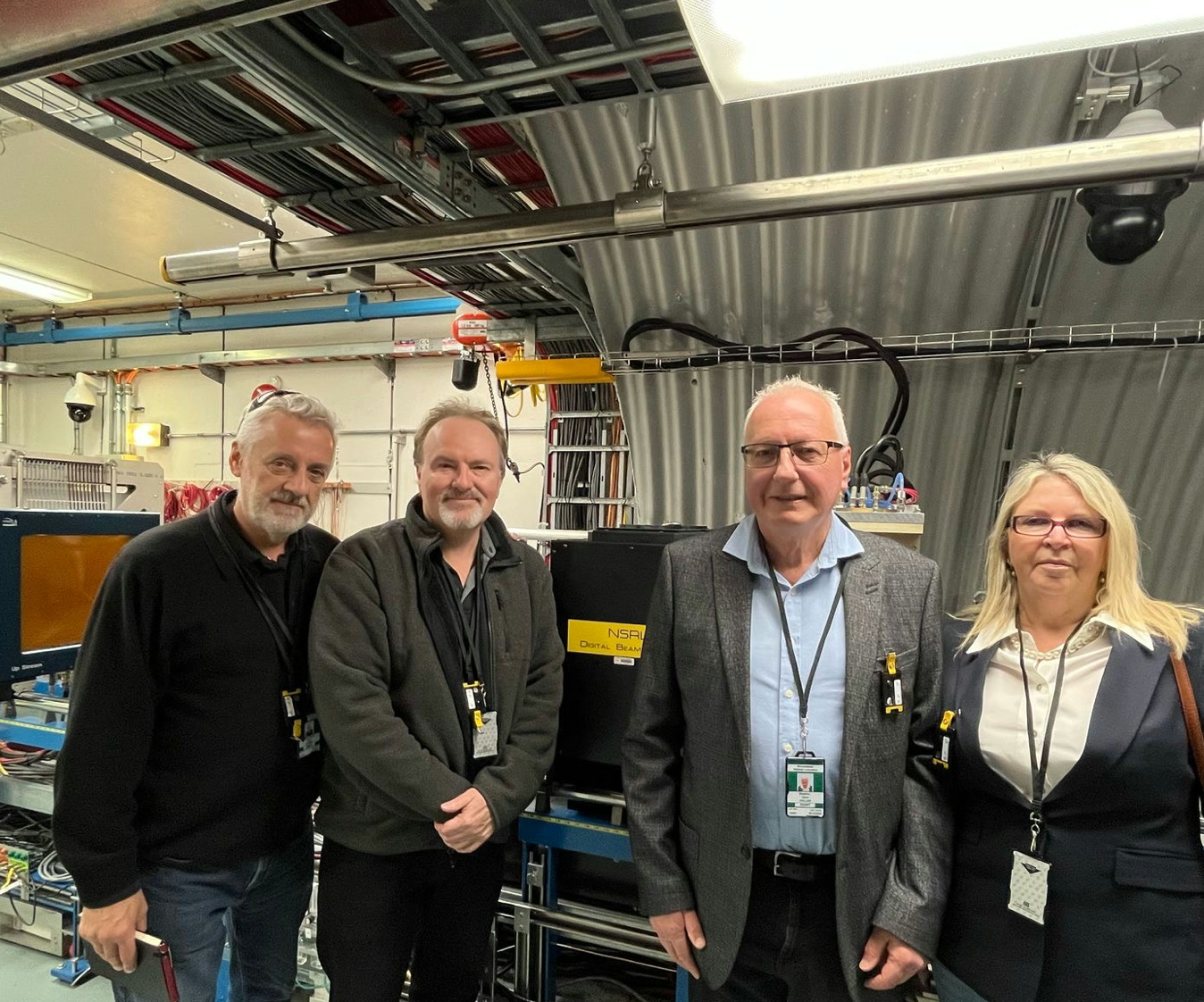
Our team at the NSRL beamline, February 2025. 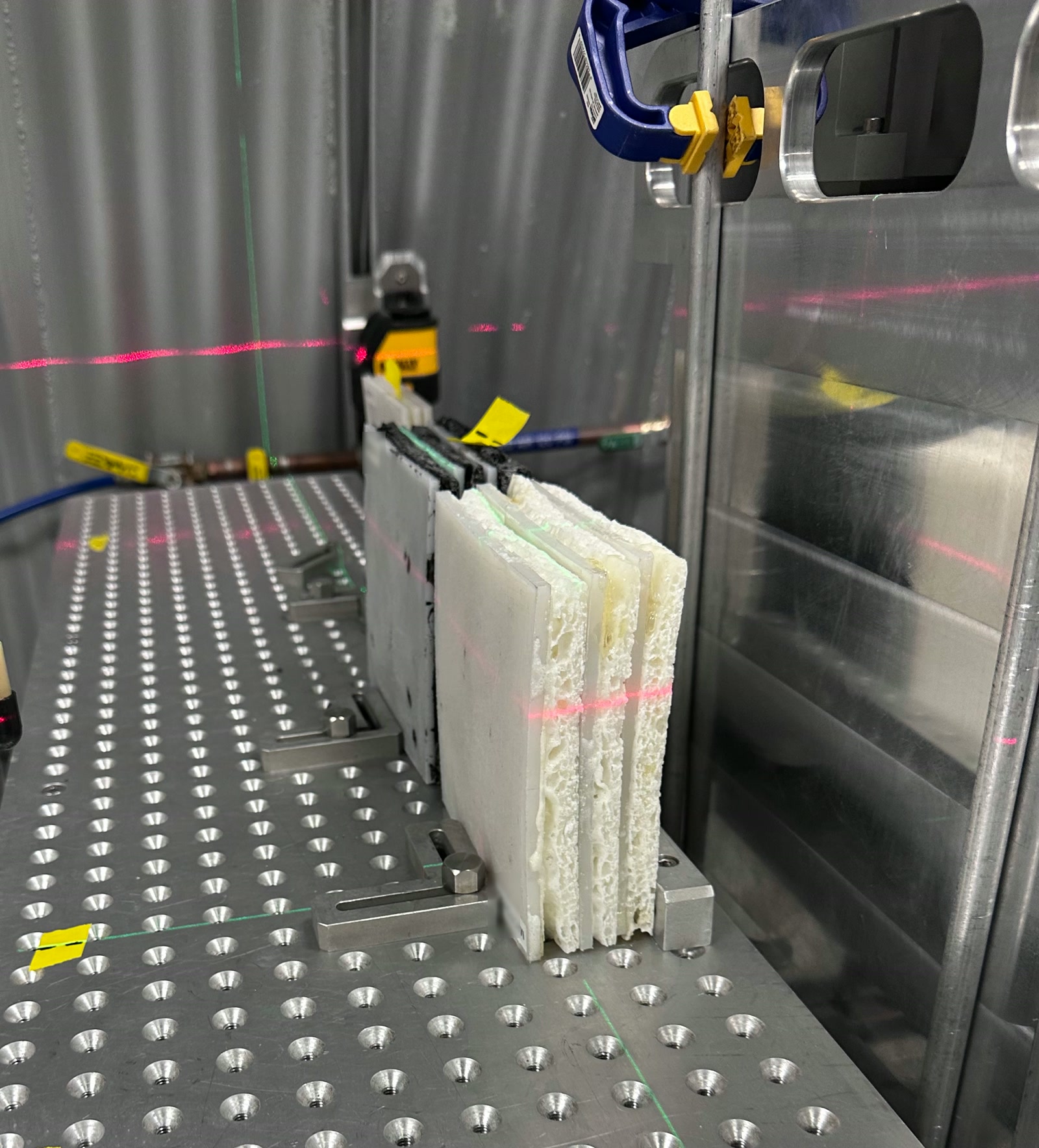
Samples lined up in the beam. 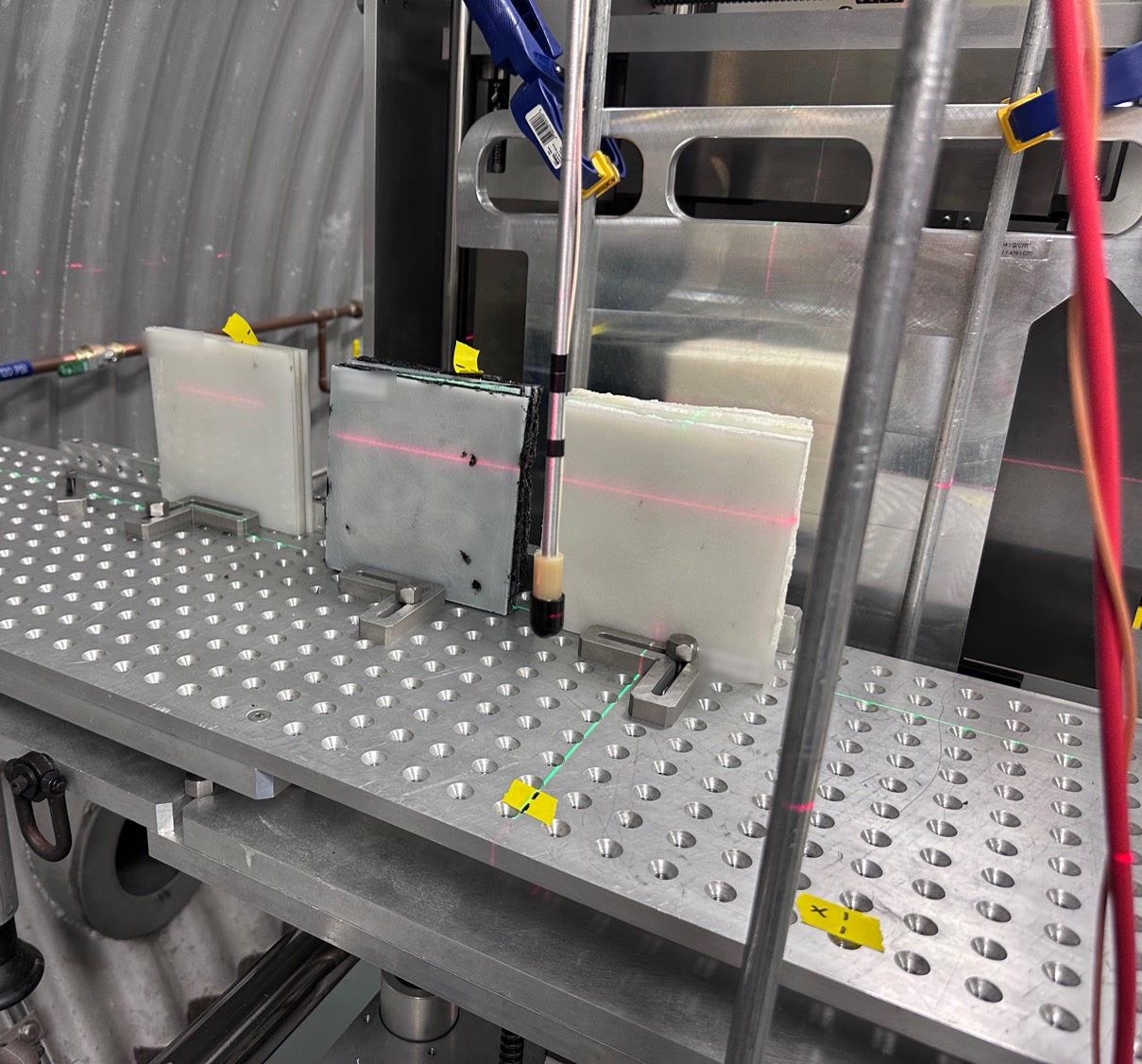
Three sets of samples on the remote test rig. 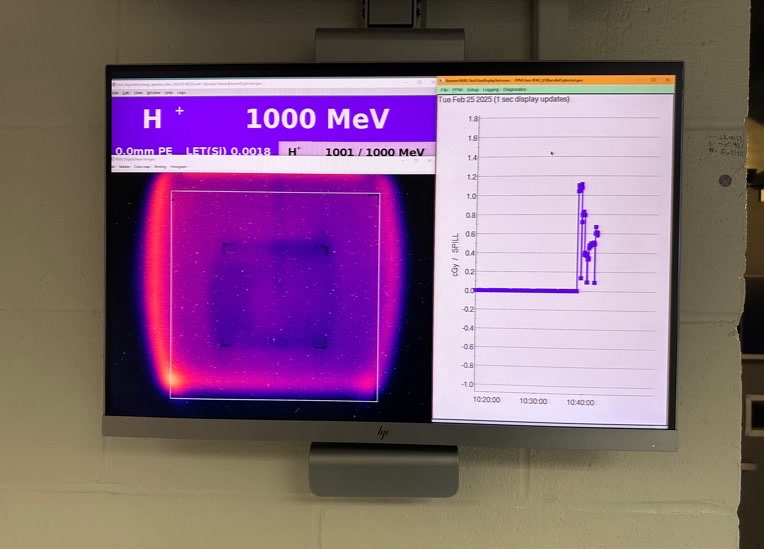
The 1,000 MeV beam on the control-room monitor. 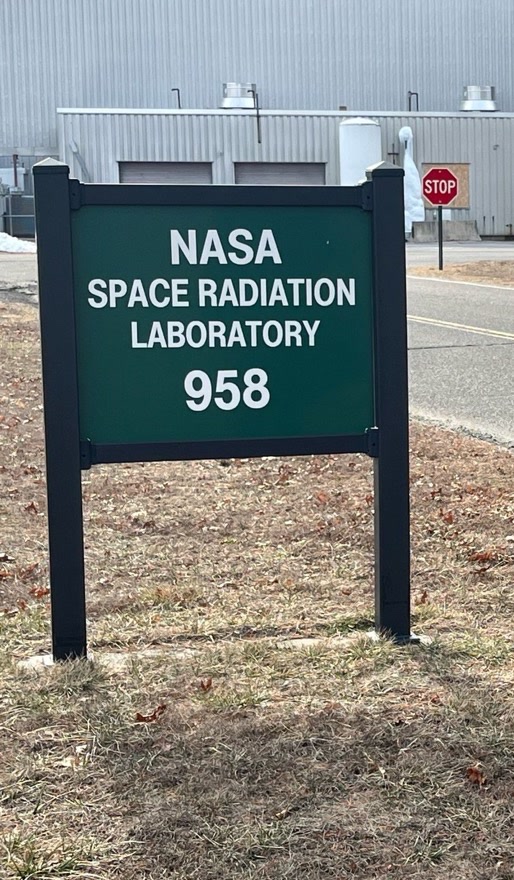
Where the samples were tested.
TRY IT
Fire the beam.
PER CM OF MATERIAL · HEAVY IONS · FEB 2025 TEST
TWO FORMS
A coating for boards. A liner for crews.
-

Board coating
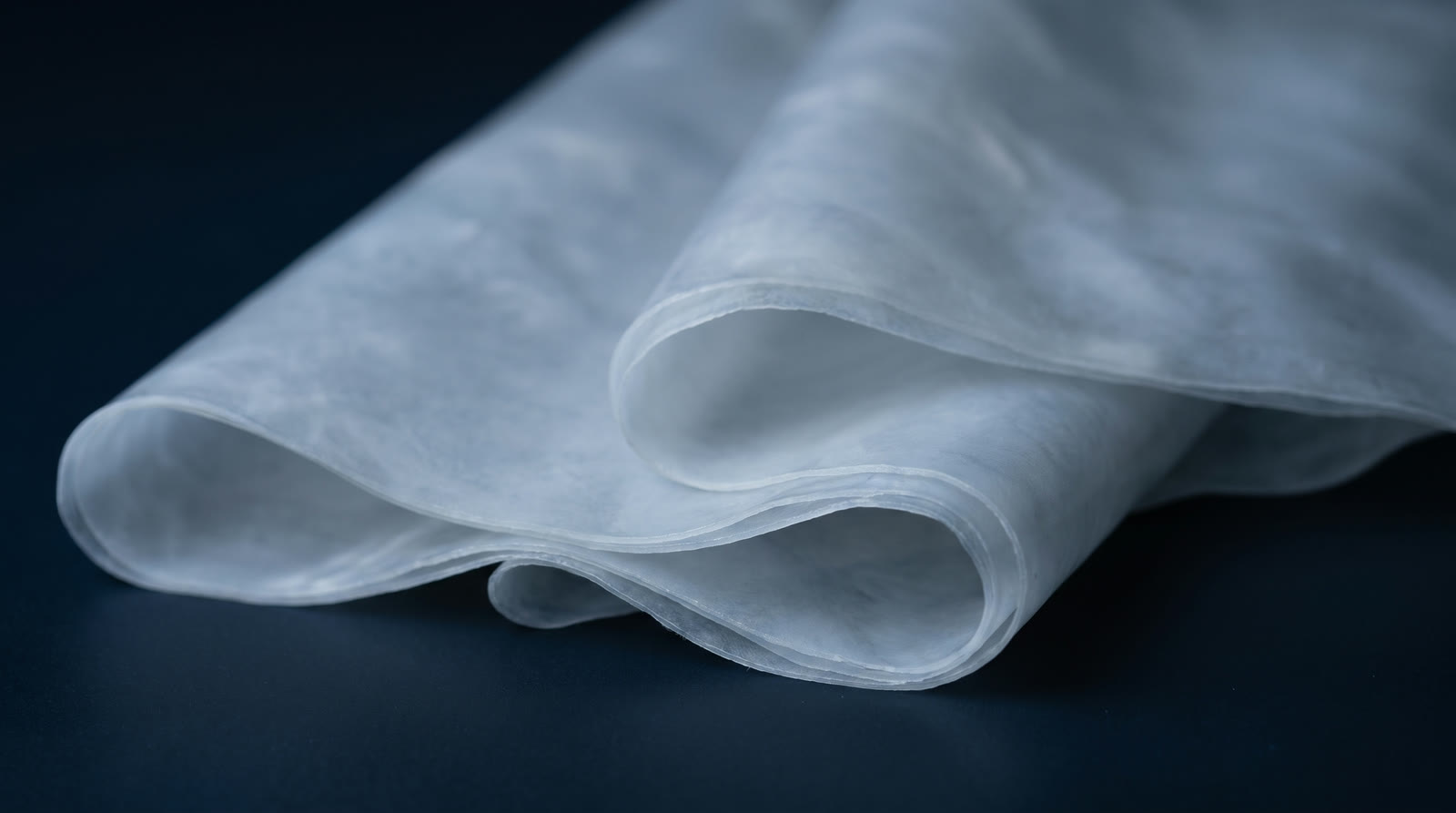
Sprayed or molded over a circuit board and its commercial chips, so they can fly where they'd otherwise need hardened parts. It's also designed to help carry heat away.
IN DEVELOPMENT
-
Crew liner
A flexible layer for space clothing, to cut the dose crews take on long missions to the Moon and Mars.
IN DEVELOPMENT
Both are made with standard polymer processes, so they can scale.
HOW IT WORKS
Light atoms against heavy particles.
Gram for gram, hydrogen is the best shield there is. Its core is a single proton, so it slows incoming particles without shattering into fragments. Metal shields do shatter, into a spray of secondary particles that can do damage of their own. Our composites pack in hydrogen, and add boron to catch the slow neutrons that make it through.
- slows particles without shattering
- Hydrogen
- catches stray neutrons
- Boron
- sprays, molds or flexes to fit
- Polymer
WHERE WE ARE
Early, tested, and building the next one.
- Alpha
Prove the idea.
Done. First samples beam-tested at the NASA Space Radiation Laboratory, Brookhaven, New York, in February 2025.
- Beta
A lab-ready material.
Underway. Co-development with a US university polymer chemistry partner began in September 2026, with more beam time and environmental tests ahead.
- Gamma
Production-ready and flight-tested.
Next. Manufacturing, and a flight test in orbit.
FOR SPACE COMPANIES
Tell us what you're flying.
Building for geostationary orbit, the Moon, Mars, or a long mission in a harsh orbit? Tell us about your boards, your chips and your mass budget. Early partners help decide what we test next.
Talk to us about your missionFOR INVESTORS
Early, tested, and raising.
Ancilia has a first beam test behind it, a patent pending, and a university partner for its next material. We're raising to fund the next stage of development and testing. Ancilia is part of the Space Technology Holdings portfolio.
Request the investor briefTHE TEAM
The people behind the shield.
-
Stephen Voller C.Eng
Founder and CEO
Stephen Voller is a UK-based Chartered Engineer and serial entrepreneur who takes new technology from pure start-up through early and late growth into production.
A specialist in hydrogen and battery energy storage systems, Stephen holds a BSc (Hons) from the University of Leeds and trained as a systems engineer at IBM, where he went on to run a business unit with sales of over $1 billion.
He has raised more than $100 million for technology businesses from Angel through Series B, established new manufacturing in China, built strategic partnerships in Japan and the Middle East, opened US offices including at NASA's John F. Kennedy Space Center, and set up joint ventures around the world.
He launched the first CE-marked hydrogen fuel cell product and is the author of more than 100 patents, including one that uses hydrogen as a radiation shield in space. He is a member of the IEEE, an affiliate member of the Royal Society of Chemistry, and a Freeman of the Guild of Entrepreneurs in the City of London.
-
Paul Simpson
Founder
Paul is a Dallas-based, UK-born U.S. citizen, a serial entrepreneur and award-winning mentor who builds and invests in fast-growing early-stage companies.
He trained in Manufacturing Systems Engineering, holds an MBA with Distinction, and came to the U.S. on an EB-1 "Einstein" visa awarded for his business expertise.
He has run operations across borders in space technology (Space Technology Holdings), IT and innovation consulting (Altran), clean energy (AlumaPower) and life sciences (Quintiles/Innovex/OrbitalAg).
Today he uses his North American network to put scalable systems in place, sharpen sales, and plan the funding and exit paths that reward founders and investors.
-
Richard Godwin
Founder
Richard Godwin is a Florida-based, UK-born U.S. citizen, a serial entrepreneur who has built companies across multiple industries, both private and public.
A venture capitalist who scales and commercializes deep tech and dual-use aerospace innovations, he describes himself as an "Orphan of Apollo" with a lifelong passion for expanding Earth's economic frontier. He holds a BSc in Mechanical Engineering and an MBA.
He combines deep technical roots with robust global experience commercializing space-derived technologies across the spaceflight sector (SpaceX, Space Technology Holdings, Celestis, NASA), venture capital (Starbridge Venture Capital), clean tech and energy (AlumaPower), and advanced Ag-Tech (OrbitalAg).
Driven by the philosophy that sustainable space-designed or space-derived endeavors require private capital and free enterprise, he leverages his specialized dual-use network and knowledge to execute rigorous technical due diligence and institutionalize highly investable, profitable structures that maximize investor returns.
STRAIGHT ANSWERS
What engineers ask us first.
Can I now use commercial off-the-shelf (COTS) components in space?
Our ultimate goal is to provide the same level of radiation shielding as rad-hardened (rad-hard) components. Today our shielding would work alongside them. When we can shield COTS components to the same level as rad-hard, then all the benefits of low-cost, low-power, low-cooling and latest release COTS components will be available in space.
Is that per centimeter (cm) or per gram (g)?
Per centimeter. Our first test measured how much each sample cut the dose for its thickness. Physicists compare shields by weight, and per-gram results are part of our next round of testing. We'll publish them here.
Can any shield stop galactic cosmic rays?
No. The most energetic particles get through any shield you could launch. The goal is to cut the dose and the damaging hits for the mass you can afford, and to absorb more neutron radiation from the sintering effect of the metal hull.
Doesn't more shielding make more secondary or sintering radiation?
With metal, often yes: heavy atoms shatter into a shower of secondary particles. Hydrogen's core is a single proton, so it has nothing to shatter, and boron catches slow neutrons. That's the idea behind our material. We haven't published a secondary-neutron measurement yet.
Does a coating replace error correction or hardened parts?
No, it works alongside them. It's passive, needs no power, and goes over the parts you've already chosen. Your error correction and watchdogs still do their job, with fewer hits to deal with.
Will it survive in space?
That's the next stage. Outgassing, thermal cycling, atomic oxygen and heat build-up over chips are all on our test plan before any flight, and we'll say so here as each one is done.
Do I need this in low Earth orbit (LEO)?
Yes, if you plan to stay there a long time, like an orbital data center. The Earth's magnetic field does much of the work in low orbits. The case is strongest beyond them: geostationary orbit, the Moon, Mars, and long missions in harsh orbits.
Has it flown?
Not yet. We have one ground beam campaign on early samples. A flight test is part of our final stage.
START HERE
Start a conversation.
Tell us what you're building or what you'd like to know. We'll get back to you within two business days.
Less gets through. Tell us what you're sending up.